
A DNA map of Lithuanian honey: what do the genetic traces of plants tell us about our honey?
How many plants are actually contained in a single spoonful of Lithuanian honey?
A beekeeper can often predict quite accurately where their honey comes from. The flowering season, the abundance of plants around the apiary, and the colour, aroma and taste of the honey provide a fairly good indication of its botanical origin. However, honey also contains much more information that human senses cannot detect.
A DNA analysis of Lithuanian honey carried out in 2024 provided an opportunity to look at honey from a different angle. Not just to ask, ‘What sort of honey is this?’, but also to find out what flora the bees encountered whilst flying around their hive.
During the study, 46 honey samples from different regions of Lithuania were analysed. The samples were collected in collaboration with associations of the Lithuanian Beekeepers’ Union, primarily with the aim of investigating the diverse summer honey characteristic of a particular region. DNA sequencing and laboratory tests were carried out at the ‘Celvia’ laboratory in Estonia, whilst the data was organised and analysed by the Urbanbee.lt team.
This study is the first step towards creating a genetic map of Lithuanian honey. At the same time, however, it allows us to view honey as a unique archive of our landscape.
Genetic traces of plants left in honey
When a bee visits a plant, traces of plant-derived genetic material may end up in the nectar it collects and other material gathered in the hive. By analysing this DNA, it is possible to determine which plants’ genetic material is present in a honey sample.
This is done using DNA metabarcoding – a method that allows the genetic traces of many different organisms to be detected simultaneously. This is a significant difference from traditional honey analysis under a microscope. Microscopic examination primarily assesses pollen grains and their morphological characteristics, whereas DNA analysis looks for genetic information. Therefore, these two methods are not substitutes for one another. They provide different information and can complement one another. The DNA method is particularly interesting in that it allows even very small quantities of genetic material to be detected. Consequently, a honey sample reveals a considerably broader spectrum of plants than we could assess based solely on a few visually dominant pollen types.
Thus, honey becomes more than just a food product. It can serve as a source of information about the environment in which bees live and forage.
Honey as the landscape’s ‘fingerprint’
One of the most interesting aspects of the 2024 study was the vast diversity of plants detected.
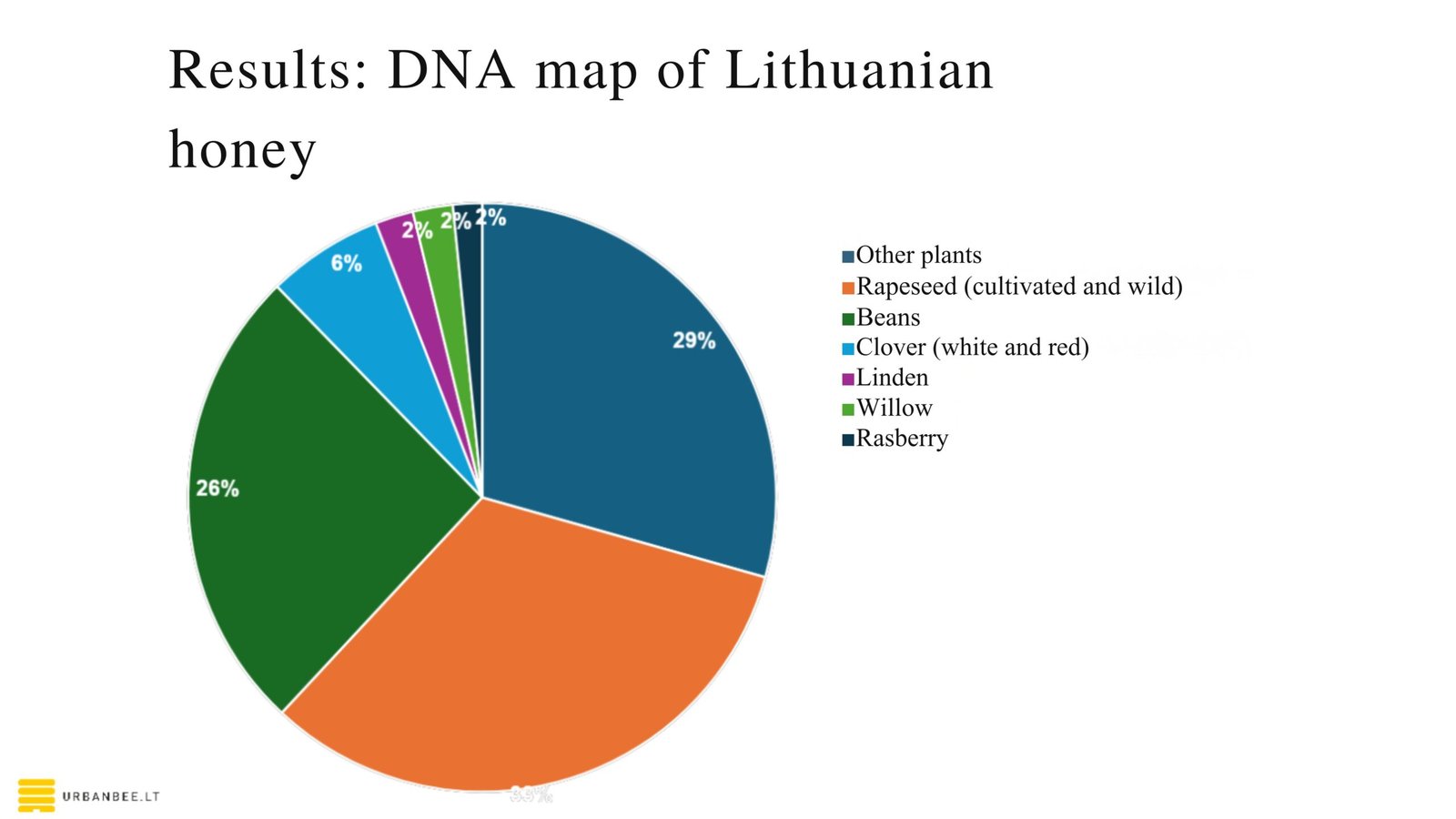
In the overall DNA map of Lithuanian honey, rapeseed accounted for the largest share – cultivated and wild varieties together made up around 32.6% of the identified plant composition. Peas accounted for around 25.8%, whilst white and red clover accounted for around 6.4%.
The ‘other plants’ group accounted for as much as 29.4% of the identified plant composition. This means that behind the few most prominent plant groups lie a multitude of other genetic traces. This is where one of the most important insights of this study emerges: multi-flower honey is not simply honey in which no single plant dominates. It can be a very complex reflection of the local landscape.
Meadows, orchards, forests, the edges of bodies of water, urban green spaces, roadsides and agricultural fields form a mosaic of different plants. Bees combine these separate parts of the landscape into a single product. Consequently, two types of honey, harvested just a few tens or a few hundreds of kilometres apart, can have completely different genetic ‘signatures’.
Every region in Lithuania has its own honey story
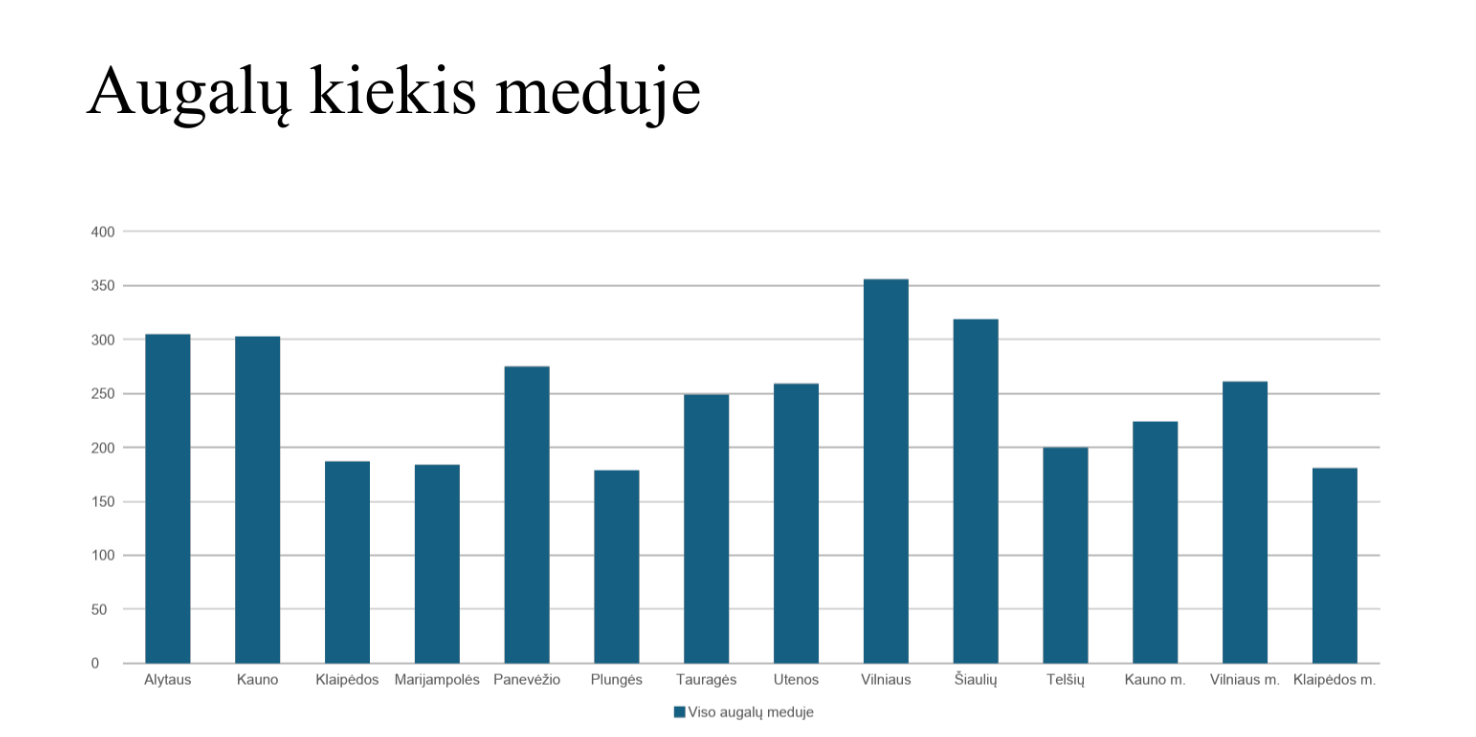
Samples taken in 2024 showed that the botanical composition of Lithuanian honey varies across different regions.
When assessing the total number of plant species identified in different regions, 356 species were identified in samples from Vilnius County, 319 in Šiauliai, Alytus – 305, Kaunas – 303, Panevėžys – 275, Utena – 259, and Tauragė – 249.
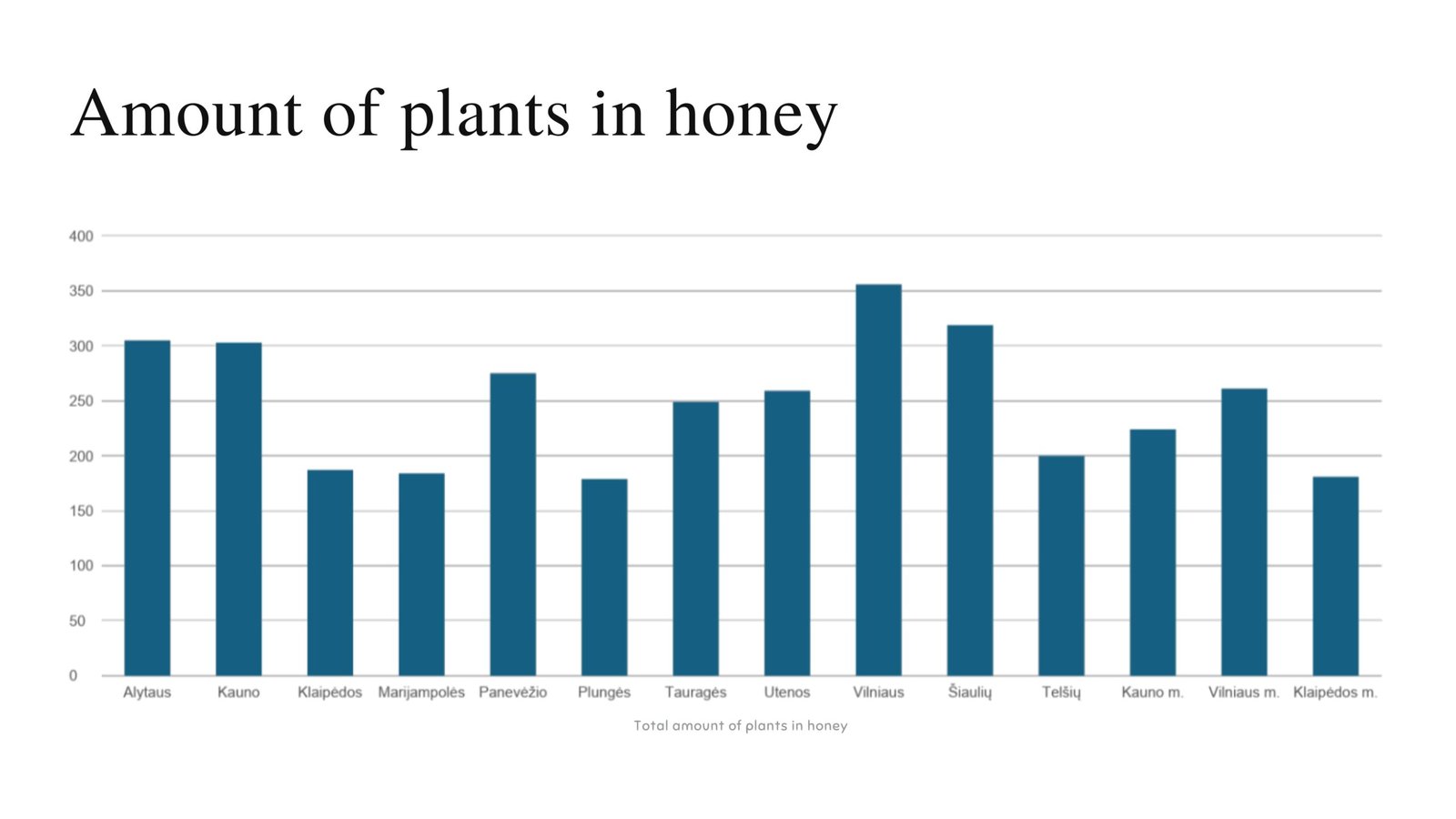
These figures should not be interpreted as a biodiversity ranking. The number of samples analysed varied across counties, and the circumstances under which they were collected differed; therefore, it is not appropriate to make direct comparisons between regions based on this indicator.
However, the data very clearly demonstrate another point: Lithuanian honey is extremely diverse. Its genetic composition is determined by what grows around the apiary, how the land is used, when the plants flower, and what the conditions were like in a particular season. For example, in samples from Klaipėda County, rapeseed accounted for around 70% of the identified plant composition. Meanwhile, in some other samples, various other plants made up a significantly larger proportion.
This means that when we talk about ‘Lithuanian honey’, we are in fact talking about a multitude of different honey stories.
The most interesting surprise – the city
Perhaps the most surprising finding of the study relates to towns and cities. We often imagine a town or city as a less natural environment than the countryside. However, from the bees’ perspective, the situation may be more complex. Parks, private gardens, squares, street greenery, ornamental plants, roadside verges and wild vegetation can form a highly diverse mosaic of flowering plants.
According to data from the 2024 study, rapeseed accounted for around 35% in the urban group, whilst the ‘other plants’ group accounted for around 30%. In the county samples, rapeseed accounted for around 34%, whilst ‘other plants’ accounted for around 29%. Among other notable plants in urban areas, linden (11%) and field beans (9%) stood out, whilst in the counties, field beans (27%) and clover (6%) accounted for a significant proportion.
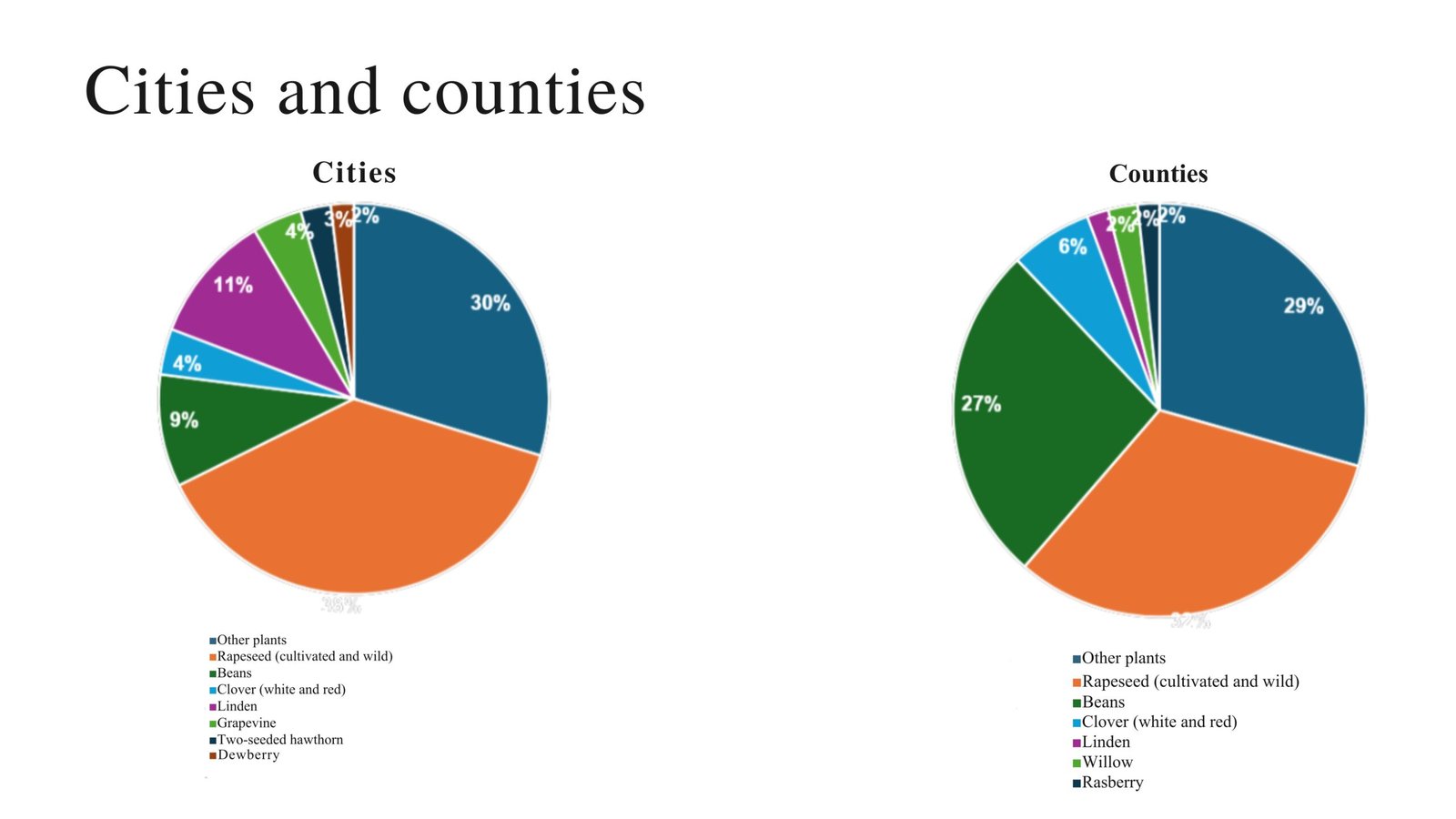
This does not mean that the whole of Vilnius is a haven for biodiversity, or that the urban environment is in every respect better for bees. However, the study’s findings allow us to view the city’s green spaces in a different light. A well-planned urban environment can provide bees not just with a single short period of mass flowering, but with a supply of various plants at different stages of the season. A similar trend was observed in Greater Manchester, where a honey DNA metabarcoding study revealed a link between a higher proportion of urbanised land around apiaries and a greater diversity of plants visited by bees.
So the question ‘are bees better off in the city?’ does not have a single, simple answer. However, one thing is clear – urban biodiversity should not be underestimated.
From abundance to the ‘green desert’
The study also highlights the paradox of intensively farmed areas. During the mass flowering of rapeseed, beans or other cultivated plants, a vast source of food becomes available to bees. Large areas of a single crop can ensure a very abundant honey yield. However, the flowering period comes to an end. If there are no flowering meadows, field margins, hedgerows, orchards or other more natural habitats in the vicinity, the landscape may remain green, but there may be a shortage of flowering plants for the bees. It is therefore important for pollinators not only how many plants grow in the landscape, but also when they flower.
This seasonality is one of the reasons why a bee-friendly environment should be assessed not just on the basis of a single period of mass flowering, but over the entire season.
A DNA map does not show exactly how much ‘honey comes from rapeseed’
The relative proportions of genetic sequences indicated in the results of a DNA analysis are not the same as the exact proportions of nectar or pollen in honey.
If the analysis determines that genetic sequences from a particular group of plants make up a certain percentage of the sample, it cannot automatically be concluded that exactly the same percentage of the honey was produced from the nectar of that plant. The results are influenced by the DNA marker used, the genetic databases, the characteristics of the plant genetic sequences, sample preparation and other methodological aspects.
Therefore, the DNA map should be understood primarily as a map of botanical diversity and its tendencies, rather than as a precise account of each plant’s contribution to the honey. This is not a weakness of the study – rather, it is an important consideration for correctly interpreting its results.
Can Lithuanian honey have its own ‘terroir’?
The concept of ‘terroir’ is well known in the world of wine – a product’s characteristics are determined by a specific location, its climate, soil, landscape and human activity. A similar idea can be applied to honey. If one area is dominated by rapeseed, another by meadows and clover, and a third by orchards, forests and urban green spaces, the bees will collect a different genetic ‘signature’ from these landscapes. This opens up an interesting prospect for beekeeping in Lithuania. In the future, we might not only be able to say that honey is ‘Lithuanian’, but also gain an ever-better understanding of which part of the Lithuanian landscape it reflects
Such data may also be useful for the production of varietal honey. By knowing the plant composition and flowering periods of a specific area, it is possible to plan honey harvesting more effectively and provide a better basis for determining its botanical origin.
Authenticity is becoming increasingly important
The genetic ‘signature’ of honey is of interest not only to researchers of biological diversity. It could become one of the tools in the broader context of honey traceability and authenticity.
In 2025, the Lithuanian Beekeepers’ Association announced the results of tests carried out at the ‘Celvia’ laboratory on 10 honey samples purchased from supermarkets; according to information published by the Association, 7 out of 10 samples were found to be inauthentic. In the same year, the State Food and Veterinary Service (VMVT) announced the results of checks on honey sold in Lithuania: foreign sugars were detected in some of the products tested at the German laboratory QSI; an investigation into possible food fraud was launched; and more than 50 tonnes of honey linked to the investigation were ordered to be withdrawn from the Lithuanian market.
This is not a problem unique to Lithuania. In a European Commission-coordinated inspection, 147 out of 320 samples – or 46% – of honey consignments imported into the EU were assessed as suspicious due to possible non-compliance with the requirements of the Honey Directive. It is important to distinguish between the different objectives of the investigation. DNA analysis is not a universal method for detecting all cases of honey adulteration. However, it can provide additional information about the biological and botanical origin of honey. The more information we have about the product, its origin and characteristics, the greater the potential for creating a more reliable traceability system.
What does this study mean for beekeepers?
Perhaps the greatest value of this study lies not in the number of plants itself, but in the opportunity it offers to view the apiary’s surroundings in a new light.
In future, honey DNA analysis could help beekeepers answer questions such as:
- which plants actually make up the bees’ forage;
- which plants are of greatest significance in a particular area;
- how the forage changes from year to year;
- how the genetic ‘signature’ of honey differs between different apiaries;
- which locations have greater potential for single-flower honey;
- how changes in the landscape are reflected in the diversity of plants visited by bees.
Again, in order to answer these questions reliably, consistent monitoring is required, rather than a single study.
2024 – just the first layer on the map
A one-year study cannot provide a complete picture of honey in Lithuania. Samples were collected inconsistently across different regions; the number of samples varied, and the exact location of the apiary or the honey flow period was not known in all cases. The study also lacked certain types of honey that are important to Lithuania – for example, buckwheat, dandelion and heather. Furthermore, every season is different. The timing and intensity of flowering are influenced by temperature, rainfall, droughts and other climatic conditions. Therefore, data from a single year primarily serves to raise questions and identify trends.
To create a reliable DNA map of Lithuanian honey, several years of consistent data, a similar number of samples from different regions and standardised collection methods would be required. It would be advisable to accurately record the location of the apiary, the time of honey collection and other information that would allow the results to be compared. It would then be possible to distinguish between what is specific to a particular year and what is a permanent feature of a given landscape.
One spoonful of honey – a miniature map of the Lithuanian landscape
Looking at the results of the 2024 study, honey turns out to be much more than just a sweet bee product. It contains genetic traces of meadows, orchards, forests, farmland, city parks and other environments. DNA analysis allows us to turn some of this invisible diversity into data. Perhaps in the future, when we taste honey, we will be able to ask not only about its flavour or colour, but also about the landscape from which it came.
Every apiary could have its own plant map. Every region – its own unique genetic signature of honey. And every year’s honey – its own story. The 2024 study is just the first chapter of this story.
Acknowledgements
This study would not have been possible without the joint efforts of many people.
We would like to express our sincere thanks to Algirdas Žiūkas, who collected honey samples from the associations of the Lithuanian Beekeepers’ Union, to the Lithuanian beekeepers’ associations, and to all the beekeepers who contributed samples and helped to cover different regions of Lithuania.
We would like to thank the team at the ‘Celvia’ laboratory in Estonia for carrying out the DNA sequencing and laboratory analyses.
Above all, our deepest thanks go to the entire Lithuanian beekeeping community. It is the beekeepers’ daily work that allows us not only to enjoy honey, but also to gain an ever-better understanding of Lithuania’s landscape, plant diversity and bee foraging grounds.
The DNA map of Lithuanian honey is only just beginning to take shape. However, one thing is already clear – when viewed through a genetic lens, honey reveals far more of Lithuania than we can see with the naked eye.