

The 2024 DNA Map of Lithuanian Honey: What Did In-Depth Genetic Studies Reveal?
In 2024, a unique and unprecedented project was carried out in Lithuania—a map of the origin of Lithuanian honey was created, showing exactly which plants bees collect honey from. Using the most advanced environmental DNA (eDNA) metabarcoding method, we were able to examine the composition of honey in far greater detail than ever before.
Key figures at a glance:
- 46 locations and samples analyzed in Lithuania.
- 361 different plant species were found in honey from Vilnius.
- Only 35% of the honey collected in the country is pure polyfloral (mixed-flower) honey.
- 29% consists of extremely rare plant species (some of which account for less than 1%), indicating high biological diversity.
How does eDNA metabarcoding work, and what makes it unique?
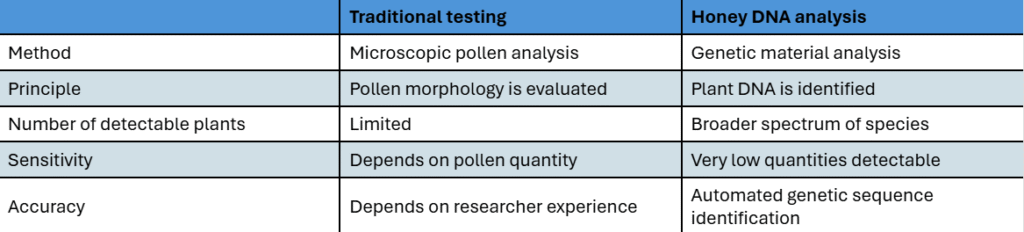
In order to determine the botanical and geographical origin of honey as accurately as possible, the environmental DNA (eDNA) metabarcoding method was applied during the study. This cutting-edge technology has been used in major scientific research projects around the world for some time and is fundamentally changing the approach to honey quality assessment.
Unlike traditional pollen analysis under a microscope, the eDNA method is based on in-depth genetic analysis. It reveals the precise genetic material of plants, which can be used to identify the plants that bees visited while producing honey. Furthermore, this analysis allows for an accurate assessment of the condition of bee foraging areas and the biodiversity of the environment.
Why is this a more accurate method? DNA testing can detect even the smallest amounts of pollen or traces of plant genetic material, and accuracy is ensured by the automatic identification of genetic sequences (which eliminates human error).
Sample Collection and Data Analysis
The study sample consisted of samples collected from 46 different locations in Lithuania. All samples met strict criteria: they had to be collected from the wild, be mixed-flower summer honey, and be characteristic of that region.
Samples from the major cities—Vilnius, Kaunas, and Klaipėda—were homogenized (combined into a single composite sample for each city) to reflect the overall condition of the city’s honey as accurately as possible.
DNA sequencing and detailed analysis of the samples were performed at the “Celvia” laboratory in Estonia. The data was compiled and analyzed in depth by the Urbanbee.lt team, which utilized artificial intelligence, the Python programming language, Excel, and other software tools.
What Did the Data Reveal? Key Findings of the Study
The data analysis revealed a particularly interesting and thought-provoking picture of Lithuania’s natural environment:
- Dominance of monocultures: Lithuanian honey is predominantly composed of monocultural plants (where one plant species is more widespread in an area and has been cultivated longer than others). Rapeseed and peas were the most commonly found in the honey.
- Polyfloral honey is a rarity: Only 35% of the honey was polyfloral. In the country, polyfloral honey is significantly diluted by agricultural monocultures.
- Abundance of rare plants: An encouraging fact—as much as 29% of honey in Lithuania comes from other plants, each of which accounts for a very small proportion (less than 1% of all plants). Such a high proportion of rare plants indicates significant biological diversity.
- Vilnius and urban honey: The city has fewer monocultures and is characterized by significantly greater biodiversity. Vilnius honey is distinguished by an exceptionally wide variety of plants—as many as 361 different plants have been identified in it—which gives the honey a richer flavor.
- Samogitia: Data show that the Samogitia region also features a high diversity of plants.
- Central Lithuania: Here, the composition of the honey is clearly dominated by monocultures.
Limitations of the Study and Future Prospects
This study is more of a review in nature, as it lasted only one year. Therefore, it reveals trends that may have been influenced by the climatic conditions of that particular year.
The sampling locations were somewhat arbitrary, the number of samples collected varied, and the sample lacked important types of Lithuanian honey (dandelion, buckwheat, and heather honey samples); consequently, the study may not fully reflect the actual situation.
Summary and Next Steps
Lithuanian honey is naturally multifloral and rich, but monocultures “dilute” it. Given that most honey is harvested from monocultures, it will be necessary in the future to assess its purity and potential pollution.
The study revealed that there is great potential for varietal honey in Lithuania, and that urban honey even surpasses non-urban honey in terms of plant diversity. Research will continue in 2025 and 2026, and since varietal honey is in high demand and has great potential, it is essential to educate beekeepers about the production of varietal honey and its benefits.
This study was made possible only through collaboration with Algirdas Žiūkas, the “Celvia” laboratory, and beekeeping associations—our sincere thanks to you all!